 rosendo
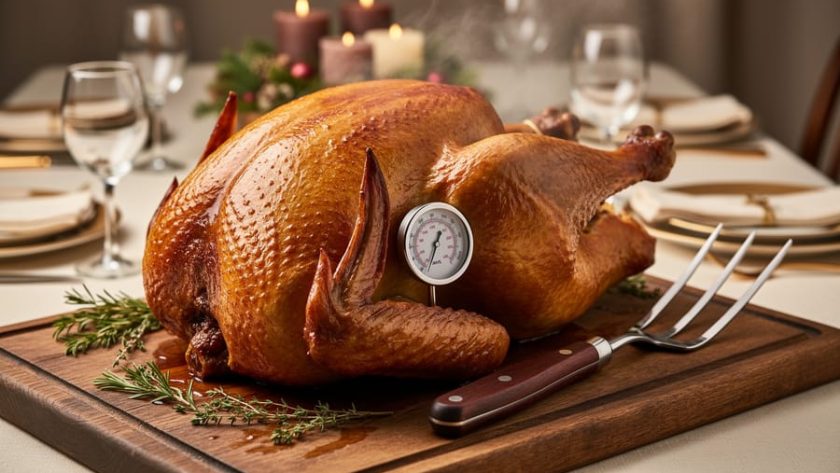
Roasting a turkey requires approximately 15 minutes per pound when cooked at 325°F to 350°F, a fundamental calculation that forms the backbone of holiday meal planning. This time-tested formula gives home cooks a reliable starting point for estimating total roasting duration, whether preparing an intimate 12-pound bird or a centerpiece 20-pounder for a festive gathering.
Understanding this baseline ratio transforms turkey preparation from guesswork into a methodical process rooted in classical French culinary principles of precision and technique. The per-pound calculation accounts for the way heat penetrates dense poultry, allowing the oven’s radiant energy to gradually raise the internal temperature throughout the entire bird. A 15-pound turkey, for example, needs roughly 3 hours and 45 minutes under these conditions.
However, this timing serves as a framework rather than an absolute directive. Variables including oven accuracy, whether the bird is stuffed, pan material, and even altitude subtly influence actual cooking duration. The true measure of doneness always comes down to internal temperature, not the clock. Your turkey reaches food-safe completion when a reliable meat thermometer registers 165°F in three critical zones: the thickest portion of the breast, the innermost section of the thigh, and the deepest part of the wing joint.
This guide walks you through the complete methodology for calculating cooking time, monitoring progress, and verifying proper doneness, ensuring your turkey emerges from the oven golden, juicy, and safe to serve.
Understanding the 15-Minute-Per-Pound Rule
The 15-minute-per-pound calculation provides a reliable foundation for estimating turkey roasting time at standard oven temperatures between 325°F and 350°F. When you multiply your turkey’s weight by 15, you establish a baseline duration that accounts for the relationship between mass and heat penetration. A 12-pound turkey, for instance, requires approximately 180 minutes (three hours), while a 20-pound bird needs roughly 300 minutes (five hours).
This timing guideline works because heat transfers through turkey meat at a relatively predictable rate when oven temperature remains constant. The density and composition of turkey muscle tissue mean that thermal energy penetrates from the surface inward at a measurable pace, with larger birds naturally requiring more time for heat to reach the innermost portions. The calculation assumes an unstuffed turkey roasted at 350°F, the temperature that balances efficient cooking with moisture retention.
However, this formula represents a starting framework, not a guarantee. Variables like oven calibration accuracy, bird shape, whether the turkey is stuffed, and even your roasting pan’s material all influence actual cooking duration. French culinary tradition emphasizes precision measurement over approximation, which is why professional chefs treat the 15-minute guideline as a helpful estimate while relying exclusively on thermometer readings to determine true doneness. The calculation tells you when to start checking temperature, not when to stop roasting.
Essential Tools and Equipment for Accurate Roasting
Achieving reliable turkey cooking results demands precision equipment, beginning with the single most critical tool in your roasting arsenal: a dependable food thermometer. Without accurate temperature measurement, the 15-minute-per-pound guideline remains merely an estimate rather than a verifiable endpoint. Professional-grade results require tools that support both the timing calculation and the final temperature verification that confirms doneness.
- Instant-read or probe thermometer capable of measuring up to 200°F with accuracy to within one degree, this is non-negotiable for food safety
- Heavy-duty roasting pan, at least 2 inches deep, sized appropriately for your turkey weight (allow 2 inches clearance on all sides)
- Flat or V-shaped roasting rack to elevate the bird and promote even heat circulation
- Oven thermometer to verify actual interior temperature, as many ovens run 25°F hotter or cooler than their dial setting
- Kitchen twine for trussing legs and securing wings (optional but promotes even cooking)
- Basting brush or bulb baster if following traditional French technique (optional)
The thermometer merits particular attention: models with a probe that remains in the turkey throughout roasting allow continuous monitoring, while instant-read versions require opening the oven door for each check. Either approach works provided the device offers quick, accurate readings at the three critical measurement points, breast, thigh, and wing. An oven thermometer, though often overlooked, protects against timing miscalculations caused by inaccurate temperature regulation, ensuring your calculated roasting duration aligns with actual heat exposure.
Critical Safety Guidelines and Temperature Requirements
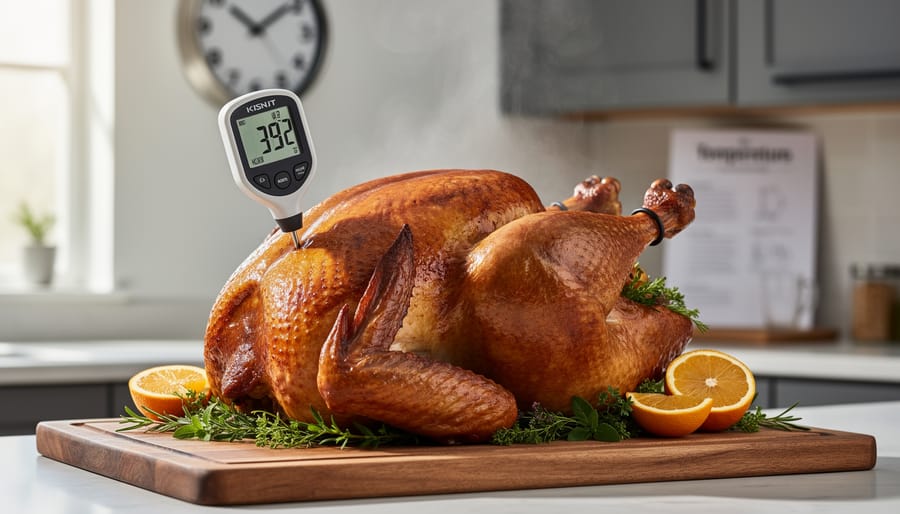
No calculation matters if the turkey isn’t safe to eat. The United States Department of Agriculture sets a non-negotiable standard: 165°F for whole poultry measured at three specific locations throughout the bird. This temperature threshold destroys harmful bacteria like Salmonella and Campylobacter that naturally inhabit raw poultry, making the difference between a celebratory meal and a serious foodborne illness outbreak.
These measurement locations aren’t arbitrary. Dark meat in the thigh takes longer to reach safe temperature than white breast meat, while the wing’s proximity to the cavity creates another thermal challenge. You must verify all three points because a turkey can register 165°F in the breast while the thigh remains dangerously undercooked at 150°F. Insert your thermometer probe deep into each location without touching bone, which conducts heat differently than muscle tissue and gives false readings.
Visual cues like golden skin or clear juices running from the leg provide helpful indicators during turkey breast cooking but they’re insufficient for confirming safety. A bird can look picture-perfect while harboring undercooked zones. Your instant-read thermometer remains the only reliable verification tool, transforming educated guessing into culinary certainty grounded in measurable food science.
Step-by-Step Turkey Roasting Process
Preparing the Oven and Turkey
Set your oven to 350°F before you begin any turkey preparation, the oven must reach full temperature before the bird goes in, which typically takes 15 to 20 minutes. While 325°F is the minimum safe threshold for roasting turkey, 350°F delivers more consistent heat penetration for whole birds and aligns with the 15-minute-per-pound calculation this method relies on.
Remove the turkey from refrigeration and let it sit at room temperature for 30 minutes while the oven preheats. Remove the neck and giblets from both cavities, then pat the entire bird dry with paper towels, moisture on the skin prevents proper browning. Position the turkey breast-side up on a roasting rack set inside your roasting pan, ensuring the rack elevates the bird at least one inch above the pan bottom to allow heat circulation underneath.
Tuck the wing tips behind the shoulders to prevent burning, and loosely tie the legs together with kitchen twine if desired, though this step is optional. Verify your oven has reached 350°F with an oven thermometer before placing the prepared turkey inside. The proper starting temperature is non-negotiable: beginning with a cold or insufficiently heated oven throws off the entire time calculation and compromises both cooking evenness and food safety.
Calculating Your Specific Cooking Time
Calculate your turkey’s baseline cooking time by multiplying its weight in pounds by 15 minutes. For a 12-pound turkey, the calculation is straightforward: 12 × 15 = 180 minutes, which equals three hours. A 15-pound bird requires 15 × 15 = 225 minutes, or three hours and 45 minutes. For a larger 20-pound turkey, multiply 20 × 15 to get 300 minutes, exactly five hours.
Write down your calculated time before you begin roasting. This baseline gives you a target window for when to start checking internal temperature, but it is not a guarantee of doneness. A 14-pound turkey, for example, calculates to 210 minutes (three and a half hours), while an 18-pounder needs 270 minutes (four and a half hours).
Treat these calculations as your planning framework, not your final answer. Oven variations, whether your turkey is stuffed, and even its shape can shift the actual cooking duration. The formula establishes when you should prepare to verify doneness with a thermometer, which remains the only reliable measure of safety and completion.
Roasting and Monitoring Progress
Once your turkey is in the oven, resist the temptation to frequently open the door. Each opening releases heat and can extend cooking time by several minutes. Your oven should maintain a steady 350°F throughout the roasting process, verify this with an oven thermometer if your appliance tends to run hot or cold.
Basting, while optional, draws from classical French techniques where building layers of flavor through careful application of pan juices enhances both taste and appearance. If you choose to baste, do so quickly every 45 minutes to an hour, using a bulb baster or long-handled spoon to draw rendered fat and juices over the breast and legs. Each basting session should take no more than 30 seconds to minimize heat loss.
Begin checking internal temperature 30 to 45 minutes before your calculated completion time. For a 15-pound turkey roasted at 15 minutes per pound, start temperature checks around the 3-hour mark of a projected 3 hour and 45 minute roast. This window allows you to catch the turkey as it approaches 165°F without risking overcooking. Insert your thermometer into the thickest part of the breast first, then check the innermost portions of the wing and thigh. If readings show 155°F to 160°F, check again every 10 to 15 minutes until all three locations reach the required 165°F.
Checking Internal Temperature Accurately
Insert your thermometer probe into the thickest part of the breast first, angling toward the center without touching bone, bone conducts heat differently and yields false readings. The probe should penetrate at least two inches deep into the densest muscle. Wait fifteen seconds for the reading to stabilize, then note whether it has reached 165°F. Withdraw carefully and repeat in the innermost section of the thigh, again avoiding bone contact, pushing the probe horizontally into the meat where the thigh connects to the body. Finally, check the innermost wing joint using the same technique.
If readings vary, common when one area cooks faster, return the turkey to the oven and continue roasting. Recheck the cooler zones every ten minutes rather than guessing based on the higher temperature. All three locations must reach 165°F before the bird is safe; a single compliant reading does not guarantee uniform doneness.
Verifying Doneness and Final Steps
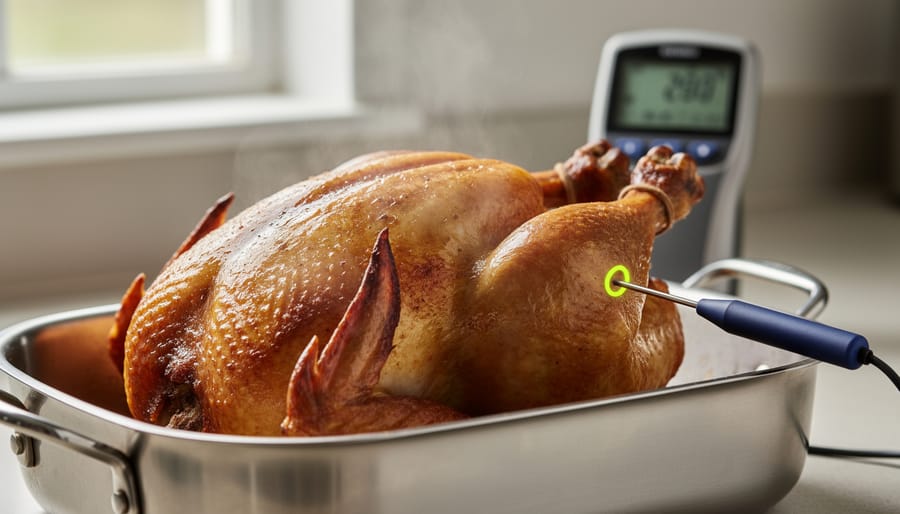
When your calculated roasting time approaches, verify doneness by checking internal temperature at all three critical points: the thickest part of the breast, the innermost part of the wing, and the innermost part of the thigh. Each location must reach 165°F. Insert your thermometer probe deep enough to reach the center of the meat, avoiding contact with bone, which conducts heat differently and gives false readings.
While temperature is your only reliable safety measure, supporting visual cues include juices running clear when the thigh is pierced and the drumstick moving freely at the joint. These indicators complement thermometer verification but never replace it.
Once all three measurement points confirm 165°F, remove the turkey from the oven immediately. Transfer it to a clean cutting board or serving platter. The resting period that follows allows juices to redistribute throughout the meat, improving both texture and moisture retention. This final stage is fundamental to French culinary technique, where proper rest transforms a safely cooked bird into a genuinely refined centerpiece.
During this rest, consider your complete meal presentation. Planning wine pairings and finalizing side dishes ensures your turkey reaches the table at its peak, surrounded by complementary elements that honor the effort you’ve invested in precise roasting technique.
Adjusting for Different Oven Temperatures and Variables
The 15-minute-per-pound baseline assumes a 350°F oven, but adjusting within the safe 325°F to 350°F range changes your timeline. At 325°F, expect closer to 17-18 minutes per pound. The lower heat penetrates more gradually, reducing the risk of dried breast meat but extending total roasting duration. Conversely, temperatures above 350°F accelerate browning but require closer monitoring to prevent overcooking the outer layers before the interior reaches 165°F.
Stuffed turkeys demand additional time, roughly 20-25 minutes per pound, because the dense filling mass slows heat transfer to the cavity and thighs. The stuffing itself must also reach 165°F, creating a second temperature target that prolongs cooking. Unstuffed birds roast faster and more evenly, making them more forgiving for timing calculations.
Oven hot spots introduce unpredictable variables. Many home ovens run 10-25°F hotter or cooler than the dial setting, and uneven heat distribution causes one side of the bird to cook faster. An oven thermometer verifies actual temperature, while rotating the roasting pan halfway through compensates for hot zones.
At altitudes above 3,000 feet, lower air pressure affects moisture evaporation and heat transfer, often requiring slight temperature increases or longer roasting times. These compounding variables, temperature variance, stuffing, oven irregularities, altitude, illustrate why the thermometer remains your definitive guide. The minutes-per-pound rule establishes when to start checking; the 165°F reading at all three critical points confirms when you’re done.
Frequently Asked Questions
The 15-minute-per-pound calculation raises practical questions during actual roasting, particularly when faced with timing decisions and temperature discrepancies. Understanding these common scenarios helps you respond appropriately rather than second-guess your technique mid-roast.
When should I start checking the turkey’s internal temperature?
Begin temperature checks approximately 30 to 45 minutes before your calculated completion time. This prevents heat loss from opening the oven repeatedly while still catching the turkey before it overcooks.
What if the breast reaches 165°F but the thigh is still below temperature?
Continue roasting, but tent the breast loosely with aluminum foil to prevent overcooking while the thigh catches up. The thigh’s denser muscle structure and proximity to the bone cavity mean it often takes longer to reach safe temperature.
Can I rely solely on the 15-minute calculation without checking temperature?
No, the calculation provides a baseline estimate, but oven variations, turkey shape, and whether the bird is stuffed all affect actual cooking duration. Always verify doneness with a thermometer at all three critical points: breast, wing, and thigh.
What should I do if my turkey finishes earlier than the calculated time?
If all three measurement points have reached 165°F, remove the turkey immediately regardless of your original time estimate. Continued roasting will dry out the meat unnecessarily.
Temperature discrepancies between different parts of the bird are normal, not a sign of technique failure. The thigh consistently requires more time than the breast due to its muscle density and bone structure. Adjusting heat shields mid-roast demonstrates responsive technique rather than poor planning. Trust your thermometer readings over your timer.
The 15-minute-per-pound calculation offers a dependable starting point for roasting turkey, much like understanding the distinctions in techniques such as simmering vs boiling provides foundational knowledge for other cooking methods. This baseline formula simplifies planning and removes guesswork from the initial stages of preparation. However, achieving true culinary precision, especially in the French tradition, where technique and accuracy define excellence, requires moving beyond time estimates alone.
The thermometer becomes your most essential tool. Verifying that the thickest part of the breast, the innermost part of the wing, and the innermost part of the thigh all reach 165°F ensures both safety and quality. Visual cues and cooking duration support your approach, but temperature readings confirm it.
View this method as a building block rather than a rigid rule. As you gain experience, you’ll develop intuition for how your specific oven behaves, how different turkey sizes respond to heat, and when to begin monitoring temperature. Mastering this foundational technique opens the door to greater culinary confidence and the ability to execute more complex preparations with precision.