 rosendo
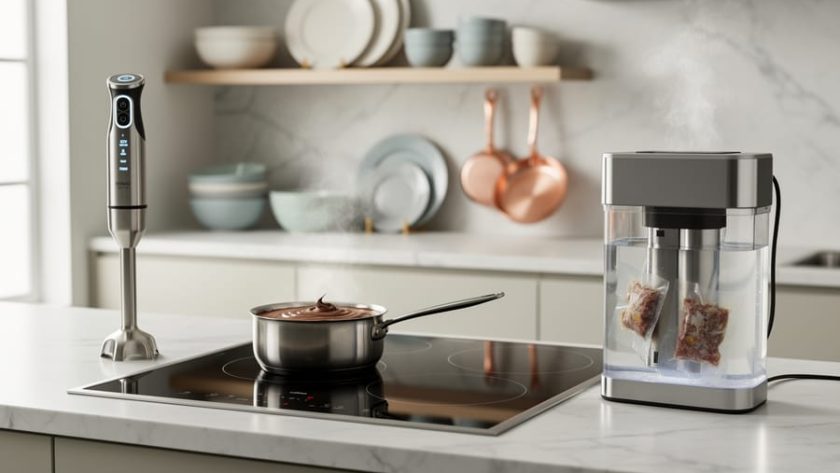
 Modern appliance innovations bridge the gap between professional French cooking techniques and the home kitchen, offering precision controls and automated features that once required years of culinary training to achieve manually. Induction cooktops now deliver the exact temperature control needed for tempering chocolate or maintaining a bain-marie. Combi-ovens regulate humidity and heat independently, making it possible to achieve a perfect crust on croissants while keeping the interior tender. Smart sous vide circulators hold water temperatures within 0.1 degrees, ensuring proteins reach ideal doneness every time.
These technological advances democratize techniques that define classical French dishes. A novice cook can now produce a silky hollandaise with an immersion blender equipped with temperature sensors, while advanced home chefs benefit from blast chillers that preserve texture and flavor for mise en place preparation. The shift isn’t about replacing skill with automation. Instead, these tools remove variables that even experienced cooks struggle to control, allowing you to focus on flavor development, ingredient selection, and plating.
Understanding which innovations genuinely improve technique versus those that simply add convenience requires evaluating how each appliance addresses specific culinary challenges. This guide examines appliances that enhance precision, consistency, and capability in ways that align with French culinary principles, helping you make informed decisions about which technologies deserve counter space in your kitchen.
The Evolution of Kitchen Appliances in French Culinary Arts
French culinary tradition has long balanced reverence for classical technique with a willingness to embrace tools that improve consistency and precision. When Auguste Escoffier systematized professional kitchen organization in the late 19th century, he was already incorporating the emerging technology of gas ranges to achieve more reliable heat control than wood-fired stoves. This pattern of selective adoption continues today as modern appliances enhance rather than replace the foundational skills of French cooking.
The introduction of mechanical mixers in professional kitchens during the early 20th century demonstrates this philosophy perfectly. While pastry chefs still needed to understand gluten development and proper emulsification, these machines freed them from hours of manual labor, allowing them to focus creative energy on refinement and presentation. Similarly, when refrigeration became widespread in the 1930s, it didn’t eliminate the need for proper garde manger technique but instead expanded what was possible for cold preparations and food safety.
The real transformation came when French chefs recognized that certain innovations could actually improve their ability to execute classical methods. Temperature-controlled water baths, for instance, make it easier to master techniques that previously required years of experience to perfect. A home cook attempting a delicate poached fish or a perfectly pink duck breast now has access to precision that once existed only in professional kitchens staffed by seasoned cooks who had spent decades developing their intuition.
Contemporary French cuisine embraces appliances that solve specific technical challenges while demanding the same understanding of ingredients, timing, and flavor development that defines traditional French cooking. The goal remains unchanged: to achieve consistent excellence through proper technique, supported by tools that remove variables and enhance control rather than shortcuts that compromise quality.
Precision Temperature Control: The New Standard for French Techniques
Sous Vide Technology for Perfect Protein Preparation
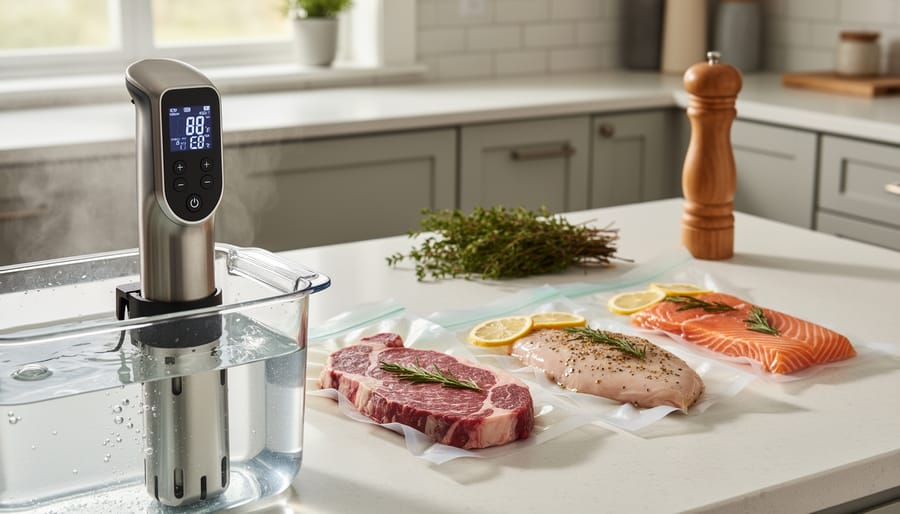
Sous vide immersion circulators have become essential tools for executing temperature-sensitive French preparations with unwavering precision. These devices maintain water baths at exact temperatures for extended periods, eliminating the guesswork that historically made techniques like poaching delicate fish filets or achieving a perfect medium-rare duck breast challenging even for experienced cooks.
For fish preparations, circulating water at 122°F produces supremely tender salmon with a silky texture impossible to achieve through conventional poaching. The controlled environment prevents the protein contraction that occurs when temperatures fluctuate, resulting in moist, evenly cooked fish from edge to center. This precision proves particularly valuable for preparing terrines and pâtés, where maintaining 145-150°F throughout the cooking process ensures proper texture development without creating dry, crumbly results.
The technology transforms meat cookery by holding proteins at their target doneness temperature indefinitely without risk of overcooking. A beef tenderloin held at 131°F for two hours reaches perfect medium-rare throughout, then needs only a quick sear to develop the Maillard reaction that creates flavorful crust. This separation of cooking and browning represents a fundamental shift in how home cooks can approach classic French techniques that traditionally required constant attention and split-second timing.
The consistency sous vide provides builds confidence, allowing cooks to master temperature-dependent preparations before attempting them through conventional methods requiring more developed intuition and experience.
Advanced Induction Systems for Sauce Work
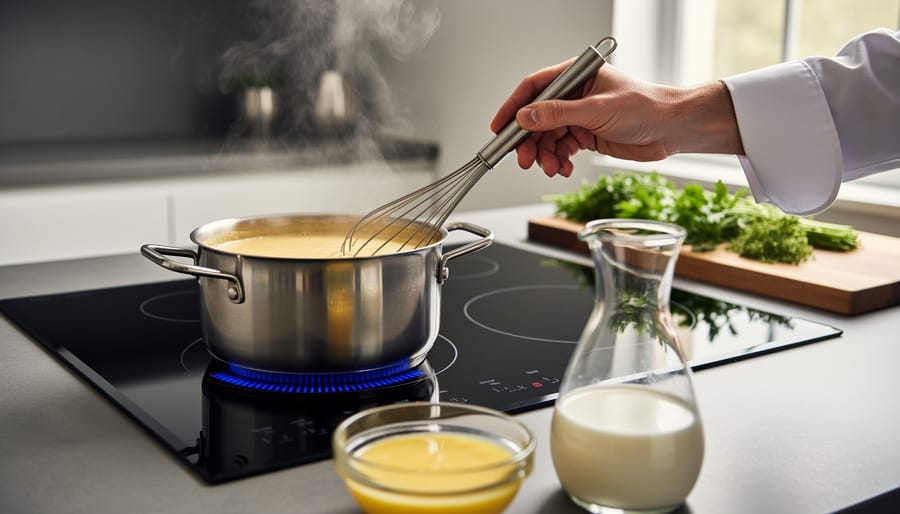
Advanced induction cooktops represent perhaps the most significant leap forward for sauce preparation since the introduction of copper cookware. Unlike gas burners that cycle flame intensity or traditional electric elements with slow response times, modern induction systems adjust power in one-degree increments and respond within seconds. This precision matters enormously when building a beurre blanc, where temperatures above 160°F break the emulsion, or when holding a hollandaise at the narrow 140-150°F sweet spot where it stays glossy without separating.
Professional chefs have long controlled heat through pan positioning and burner adjustment, constantly moving saucepans on and off direct flame. High-end induction units eliminate this dance. You set 185°F for reducing stock, and the system maintains that exact temperature while you work on other components. When making delicate mother sauces, this consistency removes the guesswork. For a classic velouté that needs gentle simmering to develop body without scorching milk solids, precise 200°F control prevents the burned-bottom taste that ruins an otherwise perfect preparation.
The true advantage emerges during service or when managing multiple French sauce mastery techniques simultaneously. Beurre rouge holds at 150°F on one zone while you reduce wine on another set to high heat, then immediately drop it to 140°F for mounting butter. This level of control, once requiring years of experience to achieve through pan manipulation and flame reading, becomes accessible through technology that responds faster than human reaction time.
Smart Mixers and Food Processors: Reinventing Classical Preparations
Modern intelligent mixers and food processors have transformed the precision achievable in foundational French preparations that once required years of experience to master consistently. These appliances incorporate sensors and programmable controls that monitor bowl temperature, adjust mixing speeds in response to batter viscosity, and execute complex multi-stage processes with reliability that surpasses manual technique alone.
For dough development, advanced stand mixers with torque sensors detect gluten formation in real time. When preparing pâte à brioche or croissant dough, the machine recognizes when proper windowpane development occurs and adjusts speed to prevent overworking. Temperature monitoring prevents friction heat from compromising butter layers in laminated doughs, a challenge that plagues even experienced bakers during manual mixing. Some models incorporate cooling bowls or pause functions that activate when dough temperature rises beyond optimal ranges for yeast activity.
Emulsification benefits significantly from precise speed ramping and consistent motor performance. Creating a stable hollandaise or mayonnaise requires adding oil at exactly the right rate while maintaining constant whisking speed. Intelligent processors with automated feed systems dispense liquids at calibrated rates matched to mixing speed, eliminating the guesswork and hand-eye coordination that makes emulsions intimidating for home cooks. The consistent results rival those achieved by chefs who have prepared hundreds of batches.
For mousses and batters, programmable mixing cycles deliver the exact degree of aeration needed without deflation. A génoise sponge requires folding flour into whipped eggs with minimal mixing to preserve volume. Smart mixers execute gentle fold-simulation patterns at low speeds with programmed pause intervals, replicating the careful hand technique traditionally taught in pastry courses. Bowl-scraping attachments ensure complete incorporation without manual intervention that might deflate delicate foams.
Temperature-controlled food processors maintain cool conditions during nut grinding for praline paste or when processing butter into flour for pâte brisée. Heat generated by friction can turn almonds oily or melt butter prematurely, compromising texture. Intelligent systems pause operation when internal sensors detect rising temperatures, preserving ingredient integrity throughout processing.
These innovations democratize techniques that previously required both knowledge and physical skill developed through repetition, allowing cooks to focus on ingredient selection and flavor development while the appliance handles mechanical precision.
Innovative Oven Technologies for Baking and Roasting Mastery
Steam-Injection Systems for Artisan Bread
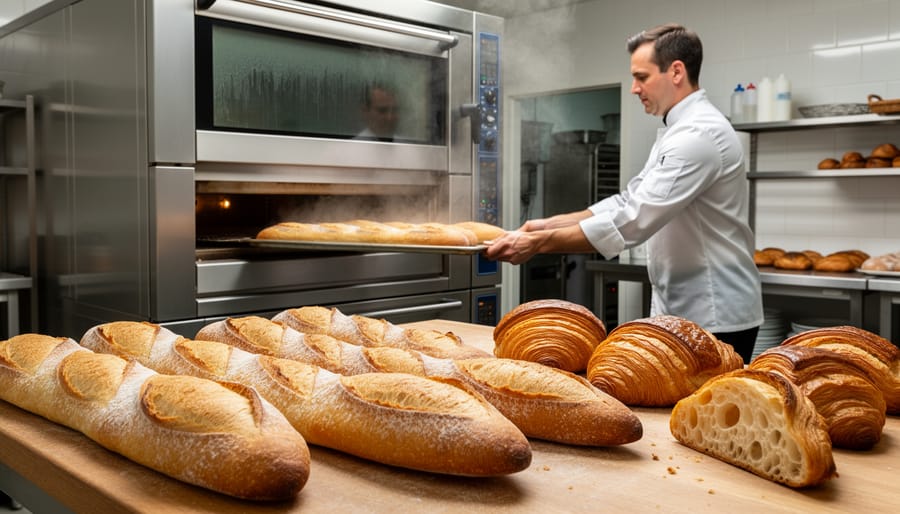
Steam injection technology has revolutionized home bread baking by replicating the professional deck ovens that produce authentic French baguettes and rustic loaves. Traditional home ovens lack the steam-generating capacity that bakeries use to achieve the crackling, golden-brown crust characteristic of artisan French bread. Modern appliance innovations now bring this critical capability to residential kitchens through built-in steam injection systems and programmable humidity control.
Professional bakers rely on steam during the initial baking phase to keep the dough surface moist and elastic, allowing maximum oven spring before the crust sets. This moisture delays crust formation, enabling the bread to expand fully and develop its characteristic open crumb structure. The steam also gelatinizes starches on the surface, creating that glossy, caramelized exterior with the distinctive crackle when the loaf cools.
Contemporary combi-steam ovens and specialized bread baking appliances deliver precisely timed steam bursts at temperatures exceeding 450°F. Many systems allow you to program steam duration and intensity, then automatically transition to dry convection heat for the final browning phase. This level of control means you can achieve the paper-thin, shattering crust of a traditional baguette or the thick, chewy exterior of a boule without improvising with ice cubes, water pans, or spray bottles that produce inconsistent results and temperature fluctuations in conventional ovens.
Multi-Zone Heating for Delicate Pastries
Traditional French pastries demand exacting heat control that many standard ovens simply cannot provide. Multi-zone heating technology addresses this challenge by creating distinct temperature environments within a single oven cavity, allowing different areas to maintain precisely calibrated heat levels during the baking process.
Croissants exemplify why this innovation matters. The base requires slightly higher heat to set the structure and create lift between laminated layers, while the delicate top needs gentler warmth to develop golden color without charring. Ovens with multi-zone capability achieve this balance by directing heat sources independently, preventing the common problem where perfectly browned tops coincide with undercooked centers or burnt exteriors mask raw interiors.
For pâte à choux preparations like éclairs and profiteroles, even heat distribution proves equally critical. These pastries need consistent temperature throughout baking to develop their hollow centers and crisp shells. Multi-zone systems eliminate hot spots that cause uneven rising, where one side puffs while another remains flat. The technology monitors temperature variations within the oven and adjusts heating elements in real time to maintain uniformity.
Laminated doughs benefit from programmable zone control that can shift heat emphasis as baking progresses. Early stages may require bottom heat to initiate lift, while later phases benefit from top heat to finish browning. Modern ovens allow you to program these transitions, removing guesswork from complex bakes.
This precision transforms inconsistent home results into the reliable, professional-quality outcomes that French pastry demands, making advanced technique accessible without constant vigilance.
Appliances That Enhance Mise en Place Efficiency
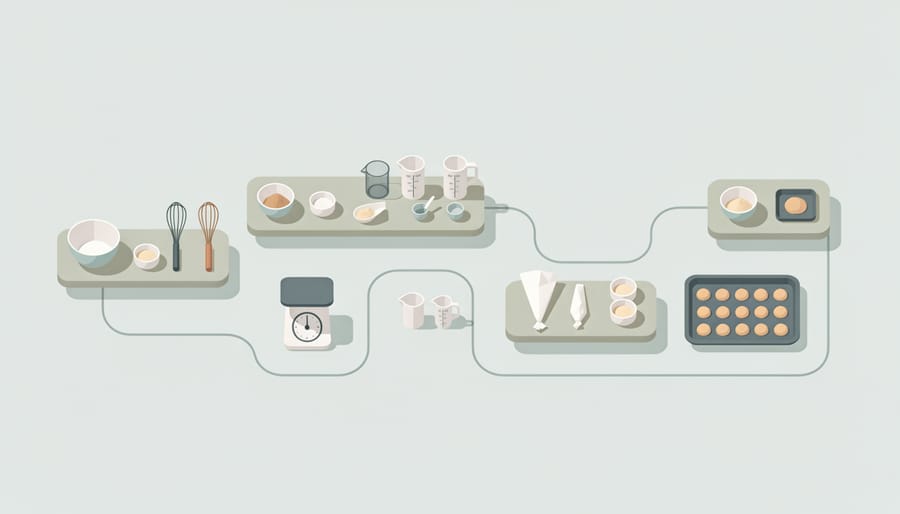
Mastering mise en place, the professional practice of preparing and organizing ingredients before cooking begins, becomes significantly more efficient with today’s innovative appliances. These tools don’t merely speed up prep work; they enhance precision and consistency, allowing you to focus on technique rather than tedious manual tasks.
High-performance food processors with variable speed controls and sharp blade systems transform vegetable prep, turning onions into perfectly uniform brunoise cuts or creating smooth purées for velouté bases in seconds. Modern processors with pulse functions give you tactile control, preventing over-processing while handling delicate tasks like cutting butter into flour for pâte brisée without warming the fat. Look for models with multiple bowl sizes and specialized attachments for slicing, grating, and emulsifying, versatility that adapts to whatever classic French dish you’re preparing.
Precision digital scales with app connectivity take measuring beyond basic weight. These scales can store recipes, convert measurements between metric and imperial systems, and guide you through multi-step preparations with timed alerts. For French baking especially, where ratios matter more than volumes, scales measuring to 0.1-gram accuracy ensure your pâte à choux or macaron batter achieves the proper consistency every time.
Rapid-cooling systems, including blast chillers scaled for home use and specialized ice-bath circulators, let you safely bring stocks, sauces, and custards down to safe temperatures quickly. This innovation matters for food safety and technique: rapidly chilled crème anglaise maintains silky texture without overcooking, and properly cooled stock clarifies beautifully when you decide what to cook next.
Vacuum sealers preserve mise en place components for days, maintaining freshness and preventing oxidation. Prepped herbs, marinated proteins, and portioned stocks remain at peak quality, letting you cook spontaneously without sacrificing preparation standards.
Selecting Appliance Innovations for Your Culinary Goals
Choosing the right appliance innovations begins with honest assessment of your current French cooking practice and where you want to grow. A novice mastering mother sauces benefits more from a precision induction burner than a $3,000 combi-steam oven, while an advanced home cook perfecting pâtisserie might prioritize a programmable stand mixer with temperature sensing. Match your investment to techniques you’ll practice weekly, not aspirations you’ll pursue quarterly.
Consider how each innovation addresses specific technical challenges in your French cooking repertoire. If you struggle with maintaining emulsion temperature during hollandaise preparation, an induction cooktop with degree-by-degree control directly solves that problem. If your croissants brown unevenly, a convection oven with multi-zone heating targets your actual pain point. Resist purchasing innovations that promise general convenience without addressing the precise techniques you’re working to master.
Quality and durability deserve equal weight with innovation features. A well-constructed induction burner from an established manufacturer will serve you through years of technique development, while a feature-laden but poorly-built alternative may fail within months. Examine construction materials, motor strength in processors and mixers, and warranty terms. Professional chefs often choose commercial-grade appliances for home use not for status, but for reliability under consistent demanding use.
Space constraints and workflow integration matter as much as capability. A countertop sous vide setup requires less commitment than a built-in combi-steam oven, allowing you to test whether the technique becomes central to your cooking before making permanent kitchen modifications. Think through where each appliance lives when not in use and how it fits into your mise en place workflow. The most innovative appliance provides no value if accessing it disrupts your cooking rhythm enough that you avoid using it.
Read reviews from serious home cooks and culinary professionals rather than general consumer feedback. A five-star rating from someone making weeknight dinners tells you little about how an appliance performs during intensive French technique practice. Look for specific commentary on temperature accuracy, consistency over extended use, and how well the innovation actually improves technique execution compared to traditional methods.
The appliance innovations transforming French kitchens today represent thoughtful evolutions of classical technique, not replacements for the fundamental skills that define this culinary tradition. A sous vide circulator brings precision to your poaching technique. An induction cooktop with exact temperature control steadies your hand as you learn to maintain the delicate heat required for hollandaise. A combi-steam oven creates the environment professional bakers rely on for perfect crust development.
These tools eliminate variables that once demanded years to master, allowing you to focus on developing your palate, understanding flavor relationships, and refining your knife skills. Technology becomes your partner in the learning process, providing consistency that builds confidence while you develop the judgment and intuition that no appliance can provide.
The path to culinary mastery still requires dedication, practice, and a willingness to learn from both successes and failures. Modern appliances simply ensure that technical limitations don’t stand between you and the beautiful dishes you’re working to create. Choose innovations that align with the techniques you’re committed to learning, invest in quality that will support years of skill development, and remember that the appliance is always the servant of the cook, never the master.